We are a Full Service Geothermal Heating and Cooling Company. We can provide you with a complete line of residential products.

We have a highly skilled and factory trained service technicians who can master any geothermal job you may have.
First of all, we're on your side! We're committed to finding the best possible comfort solutions for you and making them available at the lowest possible cost. We take our work, which is your comfort, very seriously.

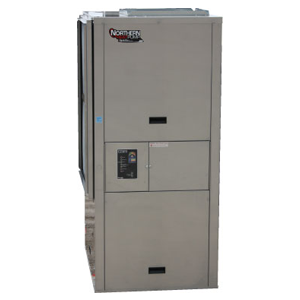
Ackerman Plumbing & Heating carries Northern Heat Pump Geothermal Systems

Closed loop systems are becoming the most common type of loops. When properly installed, they are economical, efficient, and reliable. Water is circulated through a continuous buried pipe.
The closed loop system is environmentally friendly because water in the loop prevents contamination to the external environment. The length of loop piping varies depending on ground temperature, thermal conductivity of the ground, soil moisture, and system design.
Horizontal Loops

Generally the most cost-effective for small installations, horizontal closed loop works best particularly in new construction where sufficient land area is available.
This type of geothermal heat installation involves burying pipe in trenches dug with backhoes or chain trenchers. Up to six pipes, usually in parallel connections, are buried in each trench, with minimum separations of a foot between pipes and ten to fifteen feet between trenches.
Vertical Loops

Vertical closed loops are the preferred geothermal heat system for many situations. Vertical loops are used when the soil is too shallow for trenching and to minimize the disturbance to existing landscaping.
For vertical closed loop systems, a U-tube (and, rarely, two U-tubes) is installed in a well drilled 100 to 400 feet deep. Because conditions in the ground may vary greatly, loop lengths can range from 130 to 300 feet per ton of heat exchange. Multiple drill holes are required for most installations, where the pipes are generally joined in parallel or series-parallel configurations.
Pond Loop System

A pond closed loop is a special kind of closed loop system. Where there is a pond or stream that is deep enough and with enough flow, closed loop coils can be placed on the pond bottom.
Fluid is pumped in the same manner as a conventional closed loop ground system where conditions are suitable. The economics of this geothermal heat method are very attractive, and no aquatic system impacts have been shown.
For homes around Park Rapids and the rest of Hubbard County, the everyday heating choice usually comes down to propane versus geothermal. Propane is common in this part of Minnesota because so many rural homes are off the natural gas grid. It works, but it ties your heating bills to a fuel whose price can swing sharply from one winter to the next, and you pay for every unit of heat at the burner.
Geothermal works differently. Instead of burning fuel, a geothermal heat pump moves heat that is already stored in the ground. Soil a few feet down stays at a steady temperature year round, even when the air above is well below zero. The system uses electricity to move that ground heat into your home in winter and to pull heat out of your home in summer. Because it moves heat rather than creating it by combustion, a geothermal system delivers several units of heating or cooling for each unit of electricity it uses. That efficiency is described by its coefficient of performance, or COP, and it is the core reason geothermal can heat for less than propane over a full season.
The advantage matters most in a climate like ours. Minnesota has one of the longest heating seasons in the country, often running from early fall well into spring. The more months you run the system, the more those efficiency gains add up against a combustion system. Geothermal also handles both heating and cooling from one piece of equipment, so it replaces both a furnace and an air conditioner. We do not quote a guaranteed dollar figure here because your actual savings depend on your home's heat loss, your insulation, local electricity and propane rates, and how your current system is set up. We are glad to walk through realistic numbers for your specific home.
A geothermal system costs more to install than a standard furnace and air conditioner, mostly because of the ground loop. The trade is lower operating cost for decades afterward. The way to judge the investment is the payback period, the point at which the energy savings have offset the higher up-front cost. For many Minnesota homes, geothermal payback commonly lands in roughly the 10 to 15 year range, though it varies with your fuel prices, your home, and how the system is used.
What makes the long-term math work is equipment life. The indoor geothermal heat pump typically lasts about 20 to 25 years, longer than a conventional furnace or air conditioner, while the buried ground loop is built to last 50 years or more. So well after the system has paid for itself, it keeps delivering low-cost heating and cooling on a loop that is still going strong.
There is also a federal tax credit available for residential geothermal heat pump installations, which can reduce the effective cost and shorten the payback period. The credit's amount and rules are set by the federal government and change over time, so we point you to the current IRS guidance or a tax professional for the exact figure that applies to your installation rather than quoting a percentage that may be out of date. State and utility incentives sometimes apply as well. When we put together a proposal, we help you understand which incentives may be available so you can weigh the true net cost.
A geothermal system only delivers its efficiency if it is sized correctly for your home. Sizing should be based on a Manual J heat-loss calculation, the industry standard for figuring out how much heating and cooling a house actually needs. A Manual J accounts for square footage, ceiling height, insulation levels, windows and doors, air leakage, and our local Minnesota design temperatures, rather than guessing from the size of the old equipment.
Getting the size right matters in both directions. A system that is too small will struggle on the coldest days and lean on backup heat. One that is too large costs more than it should, short-cycles, and controls humidity poorly. The ground loop has to be matched to the system as well, since loop length depends on soil conditions and the home's load. We do this load calculation up front so your geothermal system is matched to your home and your loop is matched to your system, which is what protects both your comfort and the long-term efficiency that makes geothermal worth it.
Ackerman Plumbing & Heating has installed and serviced geothermal systems in the Park Rapids area for years. If you are weighing geothermal against propane, want a Manual J load calculation, or just have questions about payback and incentives, we will give you a straight answer for your home. Our office hours are Monday through Friday, 8:00 AM to 5:00 PM.
For a closer look at the numbers, read our guide on geothermal vs. propane cost and payback in Minnesota. Financing is available on qualifying geothermal installations.